The Circle Method
A leading-edge framework for resolving conflict in community, developed by Arian Pleroma, uniting ancient principles with modern science and years of practice with people from all fields of life.
Conflict resolution is the number one priority of community work.
But it is just as complex as the human being and the human psyche itself. In Indijio we use the Circle Method, developed by Arian Pleroma. It is the unification of new scientific findings and proven methods in high-stakes conversation, a trauma-aware and sensitive approach, and timeless ancient principles, grounded in over six years of lifelong experience working with children, mothers, survivors of extreme trauma, business people, and activists.
Three streams, one container.
- 01
Modern Science
New findings and proven methods for high-stakes conversation, where the outcome matters most.
- 02
Trauma-Aware Practice
A sensitive approach shaped by survivors of extreme trauma, children, mothers, activists, and business people alike.
- 03
Timeless Principles
Ancient wisdom, refined through more than six years of daily practice in conflict resolution.
In Indijio we do not condemn hierarchies. Power dynamics must not be denied, neglected, or ignored. They must be understood.
What people ask for is usually not what they want.
Most of the time it is a mechanism they have learned to fulfill a need they are not even aware of. Arian Pleroma found that these universal basic needs are not static or mechanical. They form within a dynamic spectrum, resolved uniquely for each individual yet understandable to everyone else.
Means something very different to a small young girl than to a tall athletic man. Yet in principle, we have the means to communicate and understand it.
Means something very different to an introverted scientist than to an extroverted young woman in her twenties. Both are met where they are.
And the whole complexity of childhood trauma, with all its unimaginable facets, can still be summarized in power and the abuse of power.
Hierarchies are flattened. Time is spent until it is truly resolved.
The Circle Method is a safe container in which hierarchies are flattened and time is spent until issues have truly resolved for everyone involved. It follows the principle of emergence.
Have you ever asked yourself what separates comfortable silence from uncomfortable silence? Uncomfortable silence is all the unspoken words and thoughts that live in the space between us.
One incident is often retold for three to four hours with different friends. Sitting in the circle with everyone involved is actually the best use of our time we can imagine. The usual resistance before the circle changes into excitement and the willingness to spend more time in it.
Speak the need, and the emotion is already implied.
The Circle Method is built on the thesis that emotions carry inherent needs. It does not dwell on sensitivities and assumptions. It is a communal process to find common ground and common values. Notably, we do not use nonviolent communication: it is a beautiful remedy once escalation has happened, but it can just as easily escalate a situation or turn a conversation into a private therapy session without consent.
Injustice
Anger
Distance & Loss
Sadness
Threat
Fear
When we align our values, our emotions create a coherent field, and through this process we can truly meet each other in a safe container.
A living map of emotion, need and virtue.
The Flower integrates leading findings from cross-cultural psychology, the Stoic philosophy of inner calmness, the Vedic principles of the six poisons, and aspects of Christianity into one coherent model of human expression and balance. It maps recurring psychological patterns, supports clear and honest communication, and offers a pathway for breaking addictive cycles.
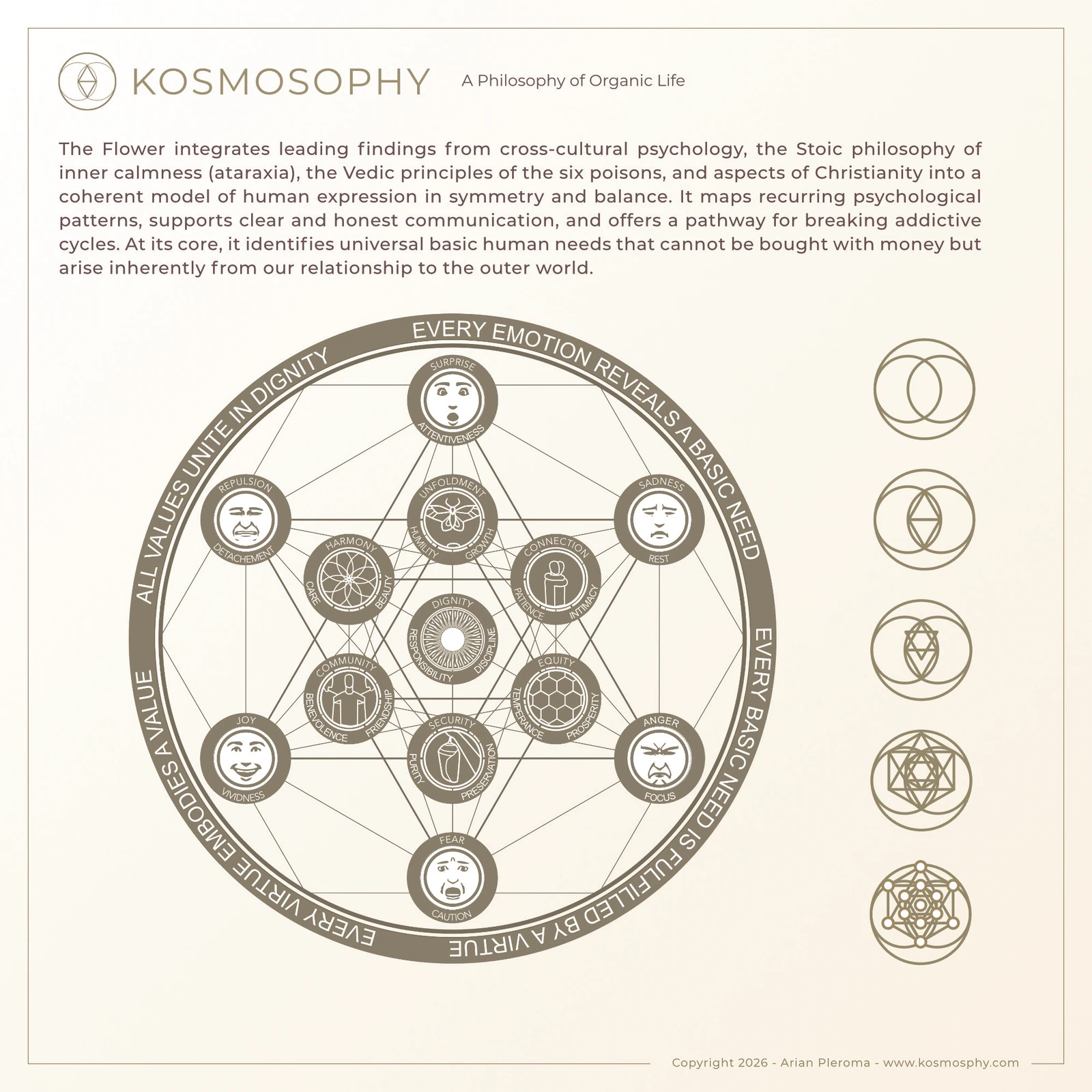
Every emotion reveals a basic need
Every basic need is fulfilled by a virtue
Every virtue embodies a value
All values unite in dignity
At its core it identifies universal basic human needs that cannot be bought with money, but arise inherently from our relationship to the outer world.
A journey into the unknown, returning with the treasure.
For this, Arian Pleroma has developed specific systems and a framework that guide as a map through conflict resolution. It follows the Hero's Journey, the blueprint for a journey into the unknown, confronting the abyss, and returning purified with the treasure.
This system of virtues and shadow aspects opens the dialogue for deeper reflection, never restricting freedom.
Departure. Abyss. Return.
Every conflict walked through the circle becomes a passage. Every person who completes it carries something back to the whole community.
Learned in steps, deepened through courses.
The systems can be learned in steps and deepened through courses. In the future we will provide resources and courses that tie deeper into the Indijio education system and the frameworks that build a strong community, forming the triadic organization built on well-known permaculture principles.